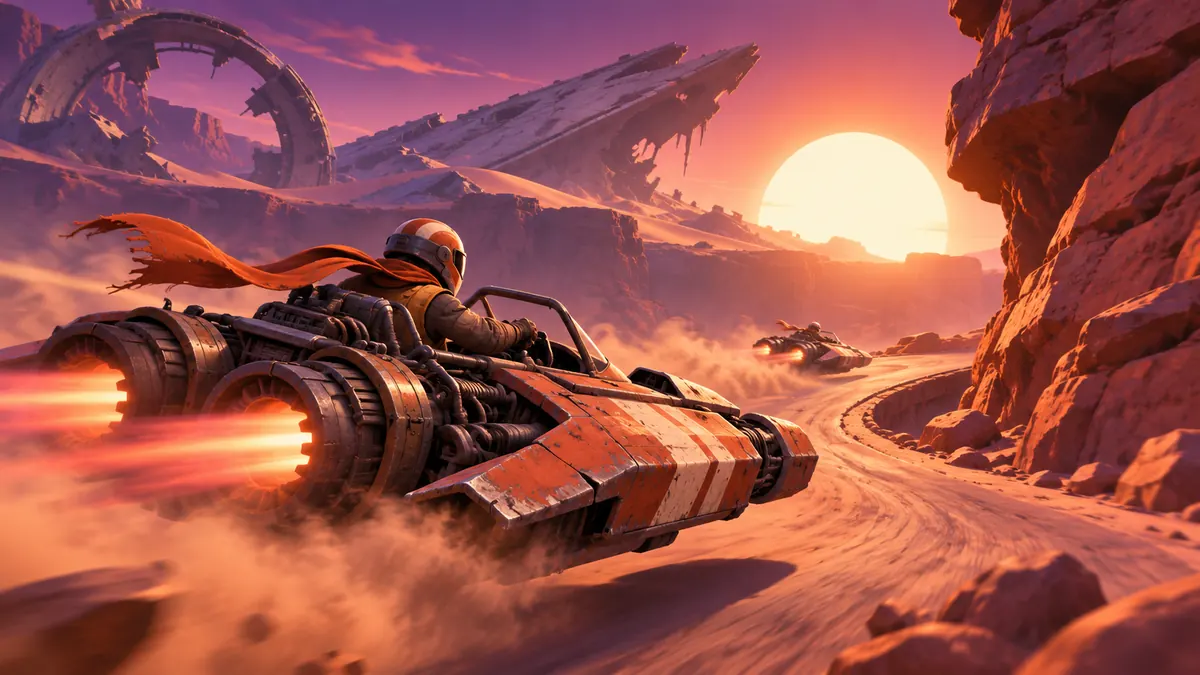
Most reviews of Star Wars: Galactic Racer agree that it's fast. The useful question is whether you can see where you're going. In Second Wind's Fully Ramblomatic review, Yahtzee Croshaw enjoys the first and runs out of patience with the second.
That makes the video a good stress test. It's a critic who warms to the racing, then names exactly where the fun stops. Other reviewers hit some of the same problems and forgave them.
This is an assessment of Croshaw's published review, checked against Game Informer and Shacknews. We haven't played the game.
What works
Croshaw praises the core high-speed racing, placing it in the company of Wipeout and F-Zero (2:35). For a certain kind of player, that comparison is most of the recommendation.
The rivals help too. Croshaw likes how the story builds character through chatter and bets during races (3:33). It gives you a reason to care who's in the next lane.
The written reviews are warmer still. Game Informer gave Fuse Games' racer 8.5 and called it an excellent racing roguelite. Shacknews' box shows a 9. If you came looking for a bad game, this isn't the one.
The corner you didn't see
The main complaint is visibility. Croshaw criticizes the lack of any track map, which makes it hard to prepare for sharp turns at speed (4:19). The difficulty is worst in Act 3 (4:10).
This one isn't a lone grumble. Game Informer also says the missing minimap adds to the sense of not knowing where you are or where you're headed. Shacknews doesn't mention a minimap, but lists trouble seeing what's ahead among its negatives.
So treat the problem as established and the severity as personal. Two outlets noticed a version of it and still scored the game highly.
The audience offered a pointed counter. The best-liked comments noted that Croshaw ignored most other abilities in favor of going faster, then struggled because everything was too fast. Others defended the criticism, saying the environments really are hard to read. Some argued that learning a track is part of racing. All of that is opinion, but it's a helpful split.
Starting over
The second complaint is structural. Croshaw sees big-budget games borrowing roguelike ideas as a poor fit, something that sits more naturally with smaller projects (2:06), and argues that repeated tracks and planets make fresh runs tedious rather than varied (4:48).
The facts underneath hold up. Game Informer explains that too many losses drop you from the tournament, and Shacknews describes having to restart an hours-long run after losing near the finish. Whether that's thrilling or a waste of an evening is the trade-off.
It's worth being honest about taste here. If losing progress usually makes you close a game, a good review score won't change that.
Should you race?
Our verdict is that Croshaw's review is sharper as a filter than as a final judgment. It's short, funny and specific, and its two big objections are backed up elsewhere. What it doesn't do is show that those objections outweigh the rest for most people.
Some practical sorting:
- Likely to suit you: you want fast, combative arcade racing and don't mind learning courses by crashing on them.
- Think twice: you rely on a map, or you get frustrated when a late loss sends you back.
- Worth a wait: you're mainly here for podracing. Shacknews says it appears in side missions, and Game Informer found those events an irritating part of the campaign.
The game is out on PC, PS5 and Xbox Series X|S, and both reviews we checked were played on PS5. If you try it, the comment section's accidental advice is the cheapest upgrade available: going a bit slower might help. In a game about going very fast, that's a strange sort of endorsement, but it doesn't cost anything.
From the creators
Watch the video
Reporting notes