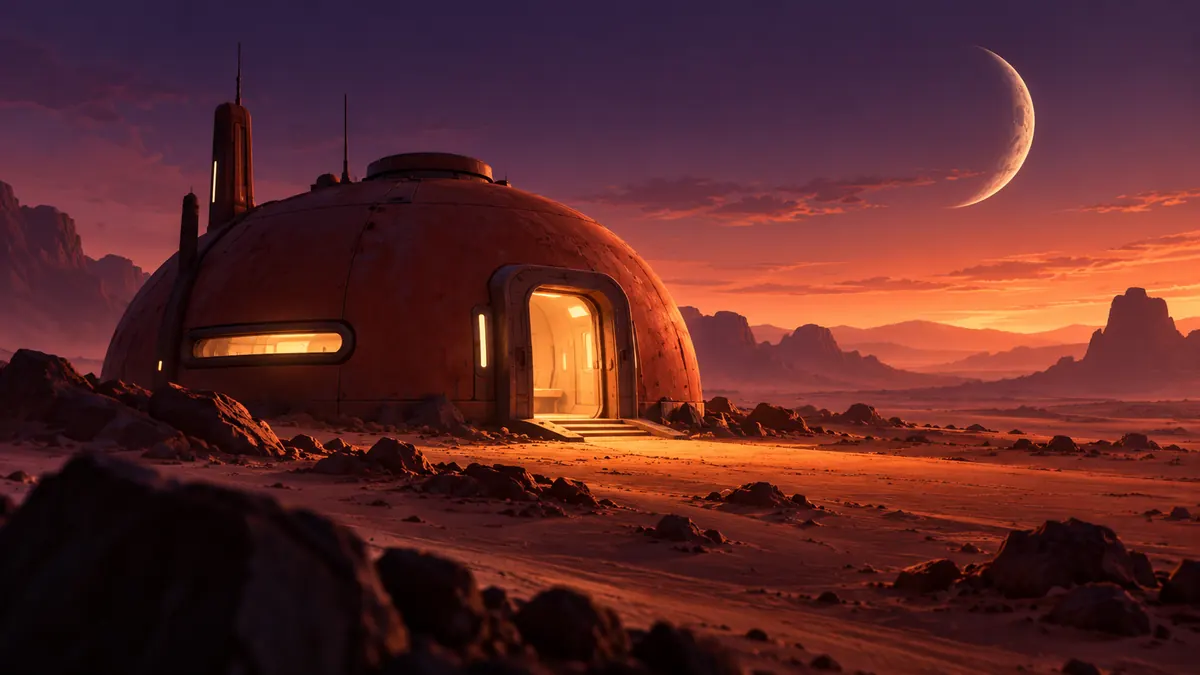
The door is open. NASA's second year-long mock Mars crew has left its habitat in Houston, ending a simulated journey that began in October 2025.
NASA published a photo on November 2 of the four-member Crew Health and Performance Exploration Analog (CHAPEA) crew posing outside "for the first time in more than a year," following the end of their simulated Mars journey on October 31, 2026. The crew are Matthew Montgomery, James Spicer, Ross Elder and Ellen Ellis.
A year and a bit, indoors
NASA's caption confirms the end date. Engadget's preview of the exit put the mission at 378 days. The four entered the habitat on October 19, 2025, as the CHAPEA mission 2 crew, and lived inside a 3D-printed, 1,700-square-foot facility on the grounds of NASA's Johnson Space Center in Houston. Engadget reported that NASA planned to stream the exit live on YouTube and its social media accounts from 3 pm Eastern time on October 31.
The work was meant to feel like Mars without the trip. According to NASA, the crew spent more than a year testing systems, maintaining crops, managing limited resources and communication delays, and conducting extravehicular activities. Engadget adds the smaller details that make an analog convincing: simulated spacewalks, habitat maintenance, growing plants, and an airlock the crew has to pass through to leave.
That stay matches the first mission's. According to Space.com, the first CHAPEA crew, commanded by Kelly Haston, left Mars Dune Alpha, a 1,700-square-foot 3D-printed habitat at Johnson, on July 6, 2024, also after 378 days.
Why NASA is doing this
NASA describes the point of the exercise plainly: to better understand how crews adapt to long-duration stays. The agency says insights from this crew's experiences will help it design its future Moon Base and plan missions to Mars. Engadget reports that NASA says data from the missions can help it optimise food system design for future lunar missions and prepare for other parts of spending long stretches in space.
What the year actually showed is still to come. NASA's November 2 post is a photo and a caption, not a set of findings, and it doesn't include any Mission 2 results.
What comes next
CHAPEA isn't the end of the line. Engadget reports that NASA has already started accepting applications for the Moon and Mars Exploration Analog, another year-long mission that combines elements of CHAPEA with NASA's other space simulation experiences. That mission will begin no earlier than August 2027, according to Engadget.
The programme has been running for a while now. Engadget notes that NASA started looking for CHAPEA volunteers in 2023 and that the first crew entered the habitat in June that year. With Mission 2 finished, two CHAPEA crews have now completed year-long stays.
Finn's take: The photo is the quietly lovely part of this. Four people who spent more than a year managing scarce supplies and delayed messages, finally standing outside together. The more useful moment comes later, when NASA says what those 378 days taught it. Until then, this is a mission completed, not a question answered.
Reporting notes