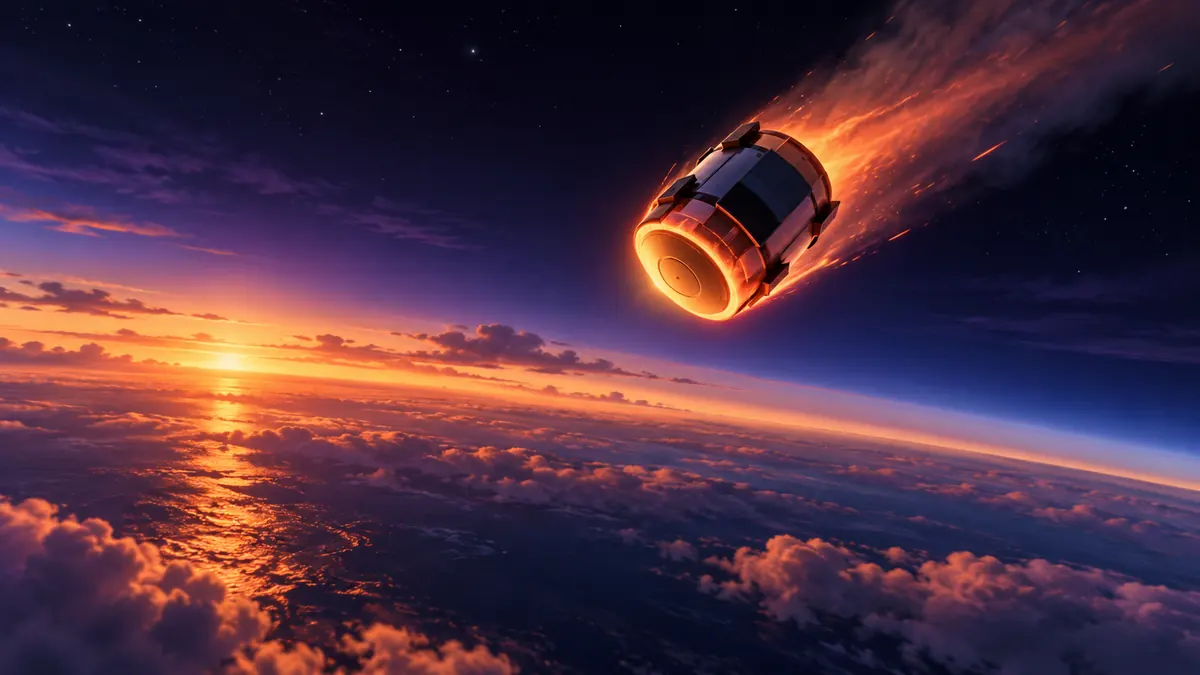
NASA's Neil Gehrels Swift Observatory spent two decades watching the most violent explosions in the universe. Its own ending will be a lot quieter, and a lot closer to home: Space.com reports the telescope is expected to fall back into Earth's atmosphere in the next few days, in an uncontrolled reentry.
How it got here
Swift launched in 2004 to study gamma-ray bursts, the most powerful explosions in the universe, and other cosmic events. According to NASA, it was designed for a two-year prime mission and ended up running science for 21 years, until rising solar activity started dragging its low Earth orbit down quickly.
NASA tried something new to save it. In September 2025 the agency gave Katalyst Space a contract to build a robotic servicing mission in less than a year, and the company's LINK spacecraft launched on July 3 on a Northrop Grumman Pegasus XL rocket from Kwajalein Atoll. The plan was to capture Swift and lift it higher. Then LINK developed attitude control problems, and on August 19 NASA and Katalyst announced it would not capture or boost Swift. In that announcement NASA said that, without intervention, Swift was likely to reenter later this year.
That point arrived in October. Space.com reports that on October 20 NASA said Swift's orbit had decayed to 171 miles (275 kilometres), and that the roughly 3,300-pound (1,500-kilogram) observatory could no longer compensate for the extra drag. It went into safe mode, and the operations team at Pennsylvania State University sent a command that effectively ended its operations ahead of reentry.
Where it could come down
Nobody can say yet exactly when or where. Space.com notes that both the timing and the location are still unclear.
What can be narrowed down is the band. Dean Sladen, an aerospace engineer at the UK components supplier Accu Components, told Space.com that Swift's orbit only passes over a band within about 21 degrees of the equator. "That band is mostly ocean, though it also crosses populated parts of Africa, South and Southeast Asia and Latin America," he said.
What might survive
Probably not much. Darren McKnight, a senior technical fellow at the tracking company LeoLabs, told Space.com that Swift will likely break up enough on reentry not to pose a ground casualty hazard, though the inner parts of its X-ray and optical telescopes might survive.
Sladen expects the aluminium body, wiring and electronics to melt away early. The most likely survivors, he said, are Swift's six heavy reaction wheels, the flywheels it used to point itself, along with tougher telescope parts such as lenses and mirrors. The mask of around 52,000 small lead tiles will almost certainly melt. "Only a handful of small, scorched fragments are expected to make it down — nothing recognizable as a telescope," he said.
Sladen also pointed out that no detailed risk assessment for Swift's fall appears to have been published. He noted that NASA's orbital debris rules cap the risk of human casualty from surviving debris at one in 10,000, said the work has very likely been done, and argued it should be made public, as NASA has done for earlier satellites.
A busier sky on the way down
Swift is far from alone. McKnight told Space.com that, with large constellations in low Earth orbit and faster hardware refresh cycles, ten times more objects reenter each year than five years ago. His bigger worry is at the other end of the problem: the rapid rate at which massive objects are being abandoned above 400 miles (644 kilometres).
Finn's take: It's a slightly unfair ending for a telescope that outlived its design life tenfold. The rescue didn't come off, but someone tried to tow a two-decade-old science satellite to safety with a robot, on a deadline set by the Sun, and that's worth remembering alongside the gamma-ray bursts. The one thing I'd add to Sladen's point: I'd like to think a published risk number would be cheap for NASA to share, and it would answer the obvious question for people living under that band.
Reporting notes