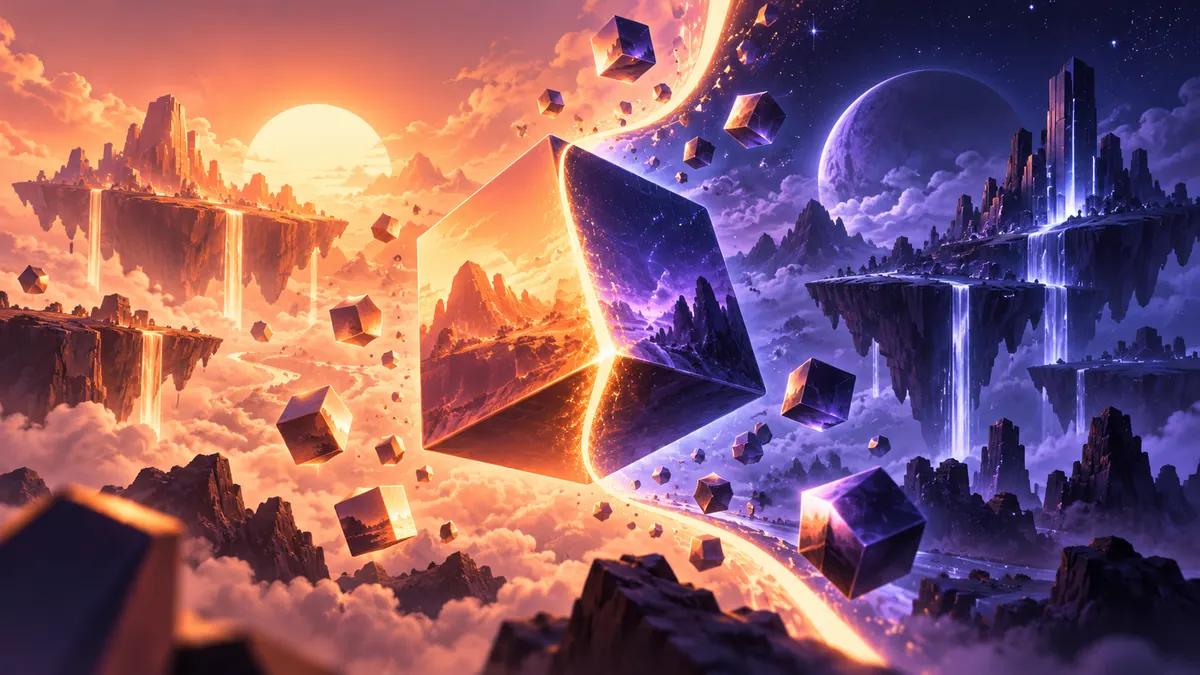
GitHub's annual game jam is back for a 14th year, and this time the one-word prompt is SHIFT. GitHub's announcement says the jam runs through November, and the itch.io jam page shows submissions open from 1 November until 1 December at 21:37 UTC, which is 13:37 PST.
Yes, 13:37. Voting closes at the same minute on 1 January.
What SHIFT can mean
The official itch.io jam page, hosted by GitHub, leaves the theme wide open: "Shift gears. Shift perspectives. Shift dimensions. Shift bits. Work the night shift. Or make a game where the only buttons are the Shift keys." How you interpret it, the page says, is entirely up to you.
The jam page also offers a list of starting ideas. Among them: a racing game where each gear changes more than your speed (second gear reverses gravity, third slows time), a puzzle-platformer where you flip between two overlapping realities, a night-shift horror game set in a convenience store, and a programming puzzler built on bitwise shifts. It also suggests a few acronyms it says it "definitely just made up", including "Suspicious Humans Investigating Feral Toasters".
The page's practical advice is the bit worth pinning above your desk: start with one mechanic and one playable level, and get those working before adding anything bigger.
How to enter (and the step people miss)
The jam page lists four steps:
- Create a free GitHub account if you don't have one.
- Join the jam on itch.io. You can sign in to itch.io with your GitHub account.
- Create a public GitHub repository for the game's source code and push your work before the deadline.
- Submit the game on itch.io before the deadline.
That last step is the one GitHub singles out. Its announcement warns: "Pushing your code to GitHub does not submit your entry to the jam." You need both the public repository and the itch.io submission.
The rules
According to GitHub, the rules are short:
- The game has to live in a GitHub repository.
- You should begin the project during the jam, although templates and starter projects are welcome.
- Any licence is fine, open or closed.
- You can enter solo or as a team.
- Any tools and assets are allowed, whether open source, commercial, commissioned or your own.
- AI-assisted development is allowed, and entrants will be asked about their AI use when they submit, so other people can see how the game was made.
So AI tools aren't banned, but entrants are asked to be open about how they used them.
Voting and results
Once submissions close, participants play and rate each other's games, and GitHub says those votes decide the winners. According to the jam page, entries are rated in six categories: Overall, Gameplay, Graphics, Audio, Innovation and Theme interpretation.
Voting ends on 1 January 2027 at 13:37 PST, and GitHub says it will announce the winners on the GitHub Blog and its social channels shortly after. The post doesn't list any prizes beyond bragging rights for the top-rated games.
How big is it?
GitHub says thousands of developers have taken part over the years, and that last year's jam, themed WAVES, drew more than 700 submissions. When we checked on 2 November (Brisbane time), the itch.io page showed more than 2,400 people had joined.
If you're new to making games, the jam page suggests engines and frameworks by language, including Phaser for JavaScript, Pygame or Godot for Python, Godot, Unity and Unreal Engine for C++ or C#, Bevy for Rust and LÖVE or Defold for Lua, along with Git and GitHub learning resources. It points to the Game Off 2026 Community on itch.io and a community-run Discord server for questions and finding teammates.
Riley's take: SHIFT is one of those themes that's secretly generous. It works as a mechanic (gears, gravity, worlds), as a setting (the night shift) and as a straight-up input gimmick (the Shift key, finally getting its moment beyond sprinting and sticky keys). Take the jam's own advice, though: one mechanic, one level, then see where it goes. A month vanishes fast.
Reporting notes