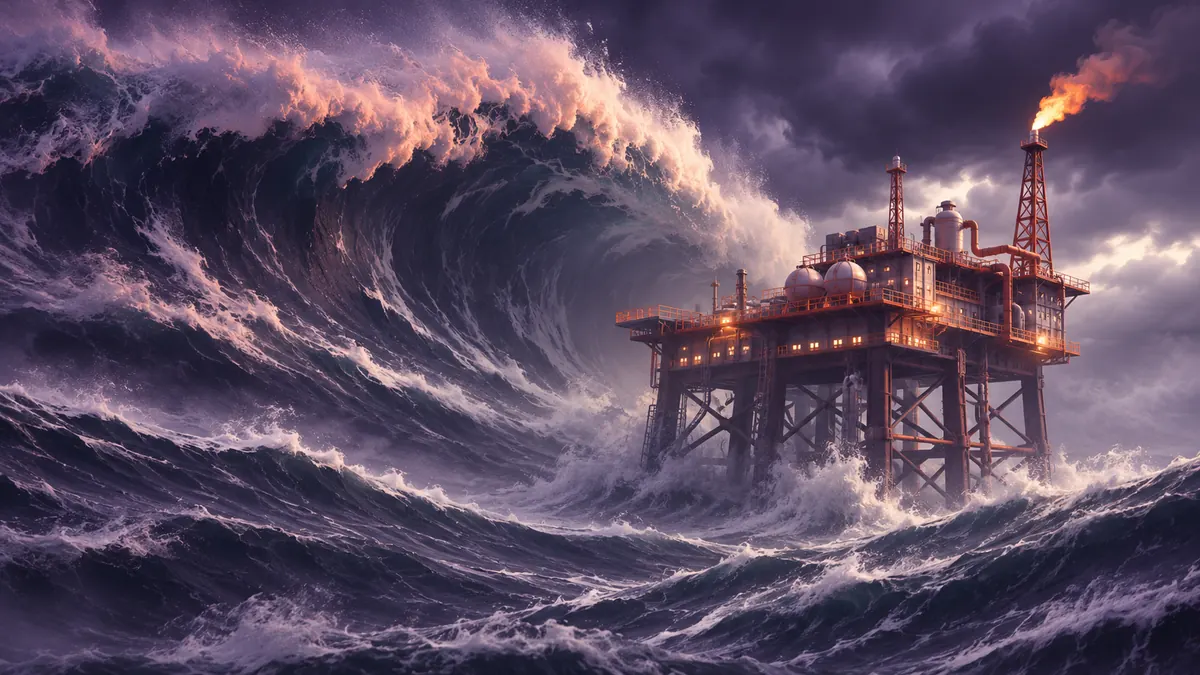
On 1 January 1995, a gas platform in the North Sea measured something the textbooks said it more or less shouldn't. Veritasium's new video starts there, with the Draupner wave, and spends the next 28 minutes working out how the ocean manages a wave that size.
It's presented by Henry van Dyck and Emilia Gyles, and it's a tidy bit of science storytelling: a measurement nobody could explain, a long history of people not being believed, and a run of wave-tank experiments that finally make the thing happen on cue. What follows is a map of what the video argues and where its claims can be checked, not a report from anyone's own trip to sea.
The wave that made the case
The Draupner reading is the anchor (0:00). Wikipedia's account of the event puts its height at 25.6 metres from trough to crest, in a sea whose significant wave height was about 12 metres. More than twice the size of its neighbours, then, and recorded by an instrument rather than a shaken sailor.
The video then moves to satellites (0:52). This part is well documented. In a 2004 article, the European Space Agency described the EU's MaxWave project, which searched three weeks of ESA radar satellite data and found more than ten waves above 25 metres around the globe. Three weeks. That's the detail that moves rogue waves from freak event to ordinary ocean behaviour.
Why they were dismissed for so long
Before instruments, there were only witnesses. The video tells the story of the French navigator Jules Dumont d'Urville, whose report of enormous waves was rejected by the physicist François Arago (3:12). Wikipedia's rogue wave article records the same episode: d'Urville reported waves above 30 metres in the 1820s, and Arago publicly ridiculed him.
The video ties that dismissal to the accepted picture of the sea, in which waves simply add together and the giant ones are vanishingly rare (6:46). ESA's article makes a similar point from the other end, describing sceptical scientists whose statistics said waves like these should turn up about once every 10,000 years.
Then there's John Scott Russell, the Scottish engineer who in 1834 followed a single wave along a canal (11:08). Russell's own account, quoted on Wikipedia, has it rolling on at eight or nine miles an hour without falling apart. George Airy and George Stokes had trouble accepting it, because the wave theory of the day couldn't explain it. Russell's "wave of translation" is now called a solitary wave, or soliton, and the video uses it as the first crack in the old model.
Making a monster on purpose
The second half is where the video earns its runtime. With teams from Imperial College London and the Okinawa Institute of Science and Technology, credited in the description, it makes rogue waves in a tank (16:48). The first trick is focusing: waves of different lengths travel at different speeds, so release them in the right order and they arrive at one spot together.
The next mechanism is stranger. In a group of waves, the video argues, one wave can take energy from its neighbours and grow at their expense (19:13). Physicists call this modulational instability, and Wikipedia's article describes the same idea of a "normal" wave drawing energy from nearby waves and briefly becoming very large.
Last comes the video's explanation for Draupner itself: two storms, two sets of waves, crossing at an angle (21:15). That's the video's case, made with researchers its description thanks, so it's worth hearing in its own words rather than ours.
Holes, light and a warning about models
The ending widens out to rogue holes, sudden troughs that mirror a rogue wave, and to rogue waves in light (23:28). Wikipedia notes a 2012 study supporting oceanic rogue holes deeper than twice the significant wave height. The closing argument is that a scientific model is a guide to reality, not reality itself, and needs changing when the sea disagrees.
What viewers took from it
The comments in the first six hours mostly followed the ending. The most-liked reactions fixed on rogue holes, with viewers unsettled that sailors have plenty of stories about walls of water and almost none about the sea dropping away. Many others turned the d'Urville story into a wider point about scientists refusing to believe observations. A few wanted more: some argued the video skipped how coastlines and lakes make freak waves of their own, and others called it one of the channel's easier watches, which they meant kindly.
It's a good half-hour if you've ever wondered how "once in 10,000 years" turned out to be such a poor description of the ocean.
From the creators
Watch the video
Reporting notes